
A football bet promises to solve a financial problem, but instead becomes the beginning of a devastating personal crisis. This contradiction drives Fatum (2023), a Spanish crime thriller directed by Juan Galiñanes. Luis Tosar portrays Sergio, a man struggling with serious gambling problems whose attempt to recover his losses places him and his family in extraordinary danger.
Álex García plays Pablo, a police officer facing a separate family crisis, while Arón Piper portrays Alejo, whose own history with gambling contributes to the central conflict. The movie connects these characters through an armed robbery at a betting shop, transforming an apparently ordinary gambling decision into a confrontation with irreversible consequences. Unlike films that concentrate on sporting predictions or financial victories, Fatum examines how gambling-related harm can extend into relationships, professional responsibilities, and the lives of innocent people. Spoilers follow.
Football Betting
Sergio's promise and the temptation to gamble again
Sergio has promised his wife that he will stop gambling. However, information concerning an allegedly fixed football match creates another temptation. He interprets the opportunity as a possible solution to his previous financial losses.
His decision to return to a betting shop establishes the movie's central conflict. Rather than accepting the consequences of earlier gambling, Sergio becomes convinced that another financial risk might allow him to repair the damage. The situation is particularly revealing because the information about the match turns out to be accurate within the fictional narrative. Nevertheless, obtaining the expected sporting result does not protect Sergio from the wider consequences of returning to gambling.
Why a winning prediction does not guarantee a positive outcome
Most sports betting narratives focus on whether a prediction proves correct. Fatum deliberately shifts attention toward the circumstances surrounding the wager. Sergio's information is unusually reliable, but his decision still carries consequences that he cannot anticipate.
The film uses this contradiction to distinguish financial outcomes from personal well-being. Even a successful wager cannot automatically restore trust, reverse previous harm, or guarantee safety. This theme also appears in Uncut Gems, where a favorable sporting result fails to prevent a personal catastrophe.

AI-generated editorial illustration; not an official film still.
The betting shop as a dramatic setting
Unlike the luxurious casinos frequently depicted in American gambling movies, the betting shop in Fatum belongs to an ordinary urban environment. Its familiarity makes the story particularly unsettling. The location represents a space that Sergio can enter without undertaking an extraordinary journey. Gambling is presented as something embedded within everyday life rather than an activity restricted to distant entertainment destinations.
For someone struggling to control gambling behavior, this accessibility can create additional difficulties. Galiñanes transforms the familiar commercial setting into a confined space where the characters must confront circumstances extending far beyond money.
Obsession and Consequences
Loss chasing and the promise of financial recovery
Loss chasing describes continued gambling motivated by the desire to recover previous financial losses. Sergio's behavior illustrates how this pattern can persist even after someone recognizes that gambling has caused serious problems.
His promise to his wife establishes that he understands the importance of stopping. Nevertheless, the prospect of recovering his money provides a justification for breaking that commitment. The supposedly fixed match becomes psychologically significant because Sergio interprets it as an exception to the risks associated with ordinary gambling. Treating one opportunity as exceptional can undermine an individual's previous decision to disengage.
Gambling relapse and broken trust
Relapse can occur during recovery from gambling-related problems. It does not establish that recovery is impossible, but it demonstrates the importance of appropriate support and sustained behavioral changes. In Sergio's case, returning to gambling also carries interpersonal consequences.
His wife expects him to respect their agreement. His children depend on his judgment and protection. The movie emphasizes that gambling-related harm can affect people who have never placed a wager themselves. Financial losses are only one component of the wider damage. Secrecy, uncertainty, broken commitments, and emotional distress can become equally significant.
The characters and their interconnected stories
Luis Tosar's performance emphasizes desperation, vulnerability, and the contradictions of a man struggling with harmful gambling behavior. Sergio is not presented as an inexperienced person discovering sports betting for the first time. He already understands that his behavior has damaged his family. His tragedy emerges from the conflict between that awareness and his inability to maintain his commitment to change.

AI-generated editorial illustration; not an official film still.
Álex García's Pablo introduces a parallel narrative centered on family responsibility and professional duty. His son requires an urgent transplant, creating an intensely personal crisis. At the same time, Pablo is expected to participate in the police response to the robbery. Both men are desperate to protect their families, but their decisions emerge from substantially different situations.
Arón Piper portrays Alejo, whose gambling-related history connects him to the environment surrounding Sergio. His arrival transforms the betting shop into the center of a criminal emergency. Alejo's storyline demonstrates how financial desperation and personal instability can contribute to circumstances affecting an entire community. Gambling disorder should not automatically be associated with violent criminal behavior; Alejo represents a fictional character within an extreme thriller narrative.
Elena Anaya portrays Commissioner Costa, whose professional decisions become central to the police response. Her character introduces questions about judgment, institutional pressure, and responsibility. The film consequently expands its subject beyond personal gambling behavior.
Gambling psychology in Fatum
Sergio's belief in the football tip illustrates the difference between confidence in a prediction and control over its consequences. Even accurate information cannot eliminate uncertainty surrounding personal relationships, financial obligations, or external events. For another cinematic examination of misplaced confidence in sports predictions, explore Two for the Money.
Under intense emotional or financial pressure, people may concentrate on an immediate objective while paying less attention to alternative choices and long-term consequences. Sergio becomes increasingly focused on recovering his lost money. His behavior illustrates how financial desperation can narrow someone's perception of available options.
Outcome bias describes the tendency to judge a decision according to its result rather than the reasoning and circumstances behind it. The football prediction turns out to be correct. Nevertheless, Sergio's decision remains harmful because it violates an important personal commitment and exposes his family to additional uncertainty.
Fatum ending explained: fate and responsibility
The central crisis brings Sergio's and Pablo's lives together through circumstances neither man could have anticipated. The robbery and its aftermath transform the movie from a gambling-related crime thriller into a drama about family, responsibility, and difficult moral choices. The narrative shifts away from the original financial objective. Money becomes insignificant compared with the consequences experienced by the characters and their families.
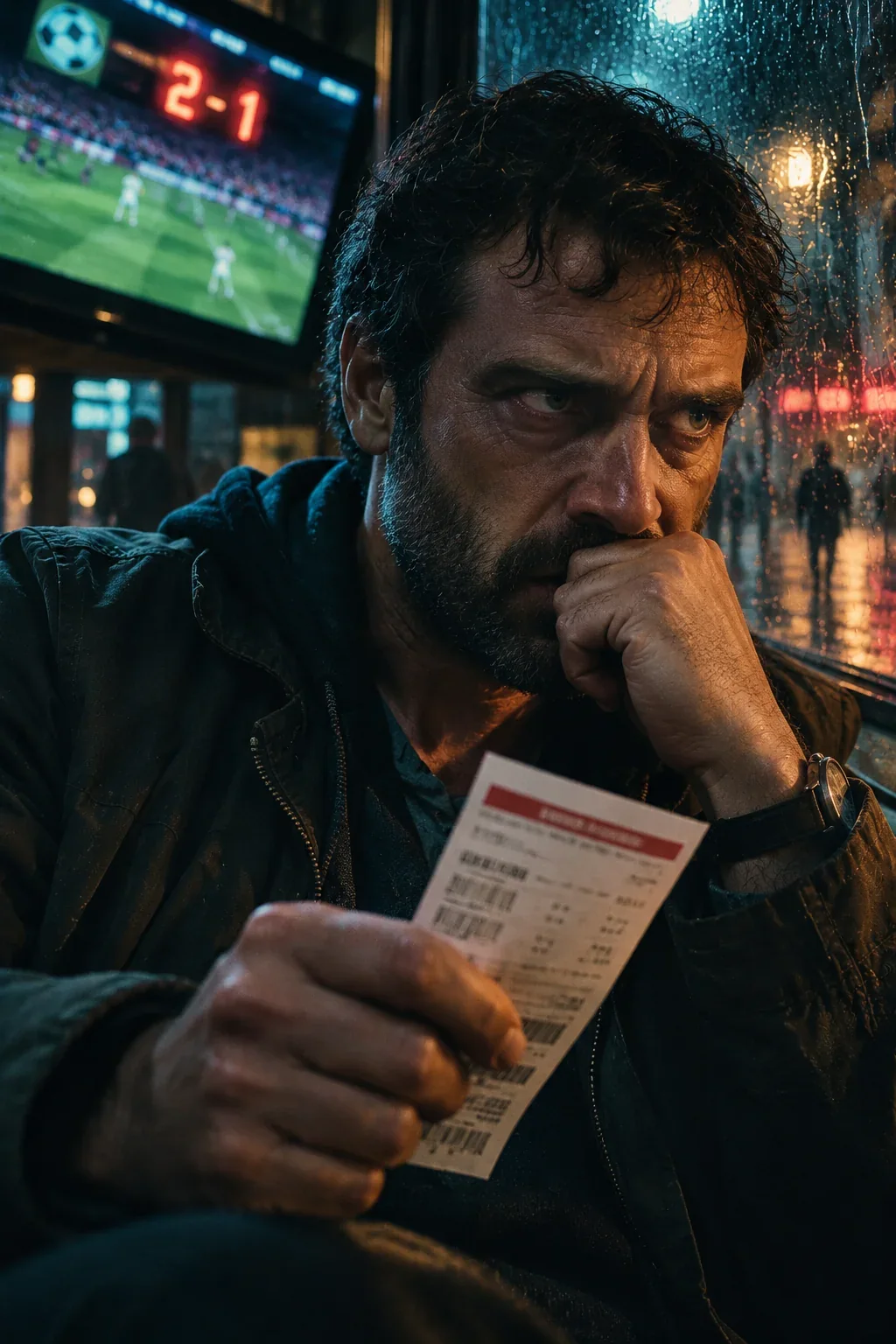
AI-generated editorial illustration; not an official film still.
The Latin word fatum means fate or destiny. Its use as the film's title introduces a fundamental question: how much of what happens to the characters results from their decisions, and how much results from circumstances beyond their control? Galiñanes does not present these possibilities as mutually exclusive. A person may be responsible for a particular decision without being responsible for every unexpected event that follows it.
Is Fatum a realistic portrayal of gambling addiction?
Although the criminal emergency belongs to thriller conventions, Sergio's difficulty maintaining his commitment reflects recognizable patterns of gambling-related harm. His financial desperation, broken promises, and attempts to recover previous losses illustrate why gambling problems cannot always be resolved through determination alone. Professional treatment, financial safeguards, social support, and restrictions on gambling access can be important components of recovery.
For a contrasting account of recovery attempts, read Win It All. Guilt and moral responsibility receive greater attention in The Card Counter.
Frequently asked questions
Is Fatum based on a true story? It presents a fictional narrative exploring recognizable social problems.
What does Fatum mean? Fate or destiny, reflecting interconnected decisions and unpredictable consequences.
What kind of gambling appears? Football betting.
Who plays Sergio? Luis Tosar.
Final thoughts
Fatum transforms a seemingly promising football wager into an examination of gambling-related harm. Juan Galiñanes explores the relationship between personal decisions, unpredictable circumstances, and responsibility toward others. Financial recovery cannot substitute for psychological recovery or restore damaged relationships automatically. The consequences of gambling cannot always be measured in money.